Proximity to Luxury

On grieving old lives and the pull to new desires.

I don’t think I ever got to properly grieve the life I lived in New York City.

I have been in London for almost three years now, about as long as I lived in New York. Since I moved, my life has taken a very different trajectory. Rather than working in the arts, I’m aiming for a career in environmental sustainability. I’m going to graduate school soon. I focus on writing more, and I have a more intentional vision for my activism and artistic practice. In my spare time, I go to the pub, I go to free museums, and I walk streets older than the United States’ Constitution.
Three years ago, I was a hopeful college student just finishing my first degree. I was spit right out of the COVID pandemic into a world where people were afraid to believe that life was continuing seemingly as normal. I smoked weed on the street before going to eat at a restaurant. I hung out on the rooftops and fire escapes of my friends’ apartment buildings. I bleached and dyed my hair like it was buying a subscription to a new streaming service. I got a new tattoo every six months, and I ate whatever frozen food I could make in under 15 minutes.
I was working primarily in theatre at the time. I signed up for production and design classes, and without even trying, most of my free time was eaten up in big chunks by rehearsals, production meetings, and design work. I did a bit of everything, but I loved stage management the most. I loved getting to know every part of a production so well that if I could split into multiple versions of myself, I could run every part of the entire show by heart. I liked being trusted to facilitate the director’s vision. In most productions, I would become so close to them throughout the process that we would become unintentional confidantes, revealing anxieties and aspirations to each other that we wouldn’t have even told friends or partners. I liked facilitating the production, allowing the piece to develop into its final form. I liked supporting every member of the company, attending to every member of the team, making sure the conditions are set so everyone can produce their best work.

Theatre was the toxic girlfriend I never had in college. She controlled who I spent time with, when I ate my meals, when I got to sleep. She would make me miss birthdays and important occasions. She would wake me up with text messages and emails in the middle of the night. If I was in the middle of plans with friends on a weekend, she would pull me into an hour-long phone conversation in the other room because ‘something had come up’ and ‘we needed to talk’. She would make me travel for two hours into the city for an hour-long meeting and then cancel at the last minute. The more she demanded, the more I gave to make her happy – even to the point of sacrificing my own health. A person I was actually dating at the time ended it after a handful of weeks because I was clearly “in a relationship with my work” and they didn’t want to be a second thought.
“I don’t want to be another bullet point on your to-do list.” They had said.
I couldn’t blame them for how they felt, but I was in my third back-to-back Tech Week in a row and didn’t really have time to feel remorseful.
Being a part of what was happening on stage was all I had wanted since I stumbled into the hobby as an adolescent. It was like being in on a big secret. And as I grew, I got closer and closer to the centre of it.
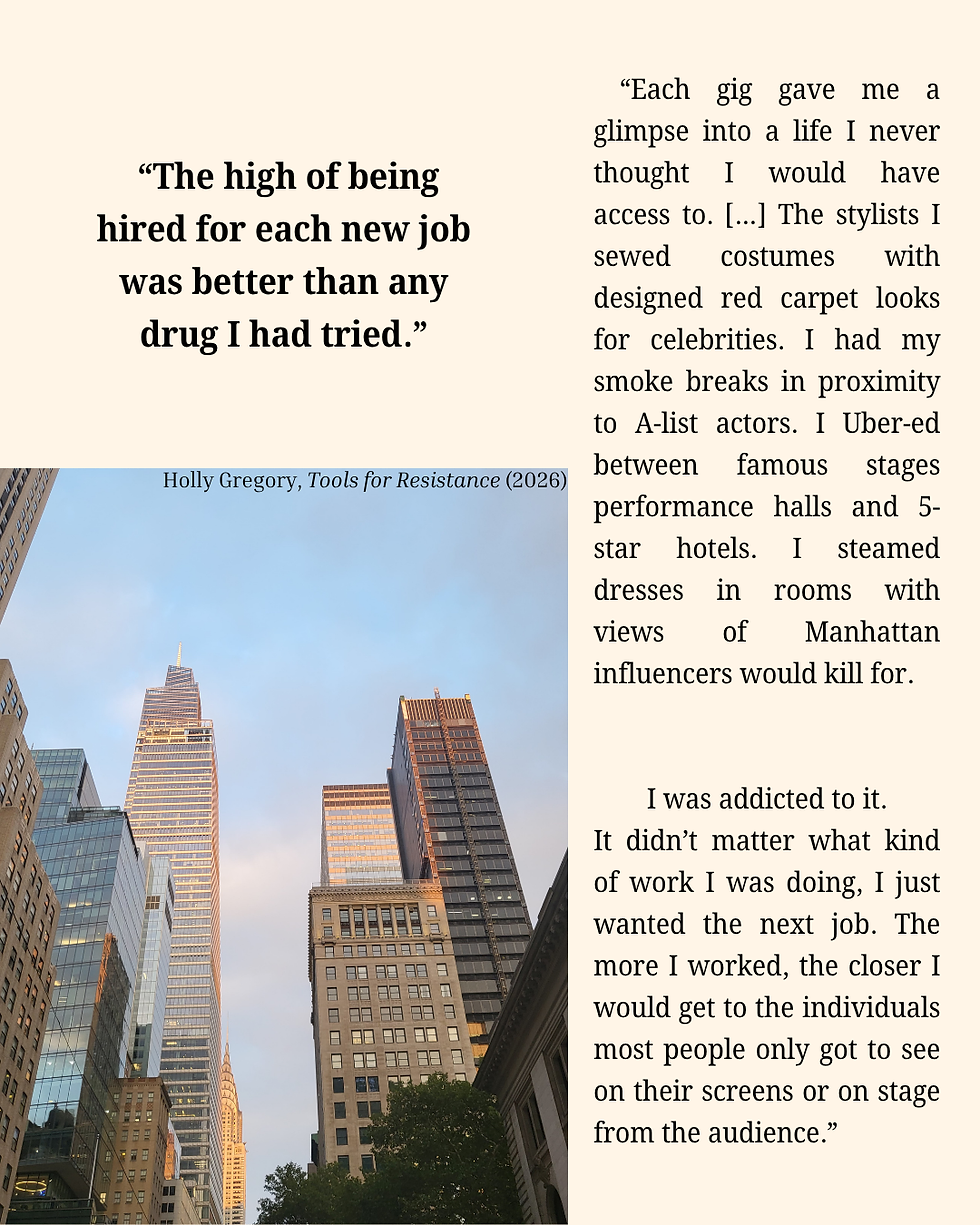
By the time I was 21 years old, I was doing pretty well. I picked up every job I could take from set and costume design, to assistant stage management and producing, to the smallest wardrobe crew role. And after every gig, I would get offered another one. And another one. The high of being hired for a new job was better than any drug I had tried. Someone wanted me to help on their project? I could never say no.
My early career success was, of course, not without the help from good friends, professors, and valuable coworkers who recommended me for roles and passed my details on to directors and producers, who then took a chance on me and hired me despite being so new to the industry. But as new as I was, I showed up to every stage, every green room, every rehearsal space with my utmost dedication and the desire to highlight everyone’s best work. I really wanted to be in the room, and people could tell.
One of the highlights of my career was the opportunity to work as assistant to the costume designer of the opening and final number of Broadway Bares. This is an annual burlesque show organised by Broadway Cares/Equity Fights AIDs to fundraise money towards humanitarian initiatives all over the world. The designer I was working directly under won an Emmy for her work on a popular TV show. I had helped her out by covering a corporate gig she had been double booked for, a gig I was more than happy to take as they paid about twice as much per hour as I was used to. As a way to say thank you, she invited me as her assistant for the day as we ran a rehearsal and two shows. This particular show starred dozens of famous, award-winning Broadway stars. Not to mention the notable choreographers, directors, and producers in various impressive heights of their careers. It wasn’t everyone in the industry, but everyone there was someone – at least in the world of Broadway Theatre. And I got to meet them all while sewing buttons and velcro on thongs and brassieres.
This gig, among others, gave me a glimpse into a life I never thought I would have access to. The people I worked with weren’t just big in theatre, but in entertainment in general. The stylists I sewed costumes with designed red carpet looks for celebrities. I had my smoke breaks in proximity to A-list actors. I Uber-ed between famous stages and performance halls and 5-star hotels. I steamed dresses in rooms with views of Manhattan influencers would kill for.
I was addicted to it. It didn’t matter what kind of work I was doing, I just wanted the next job. The more I worked, the closer I would get to the individuals most people only got to see on their screens or on stage from the audience.
I have always taken special pride in my work. When my career was doing well, it didn’t matter if the rest of my life was in shambles, nothing could make me feel bad. If I was still getting work, and the work was getting me closer to famous people in fancy places, then I had to be doing something right. And the work then began to represent my life as a whole. I was successful and I was achieving, therefore my life was worth living.
When I moved from New York City to London with no real plan, I wasn’t prepared to lose both the life I had built there and everything that I valued so deeply up until that point.
Now, almost three years later, I know I still haven’t grieved my life in New York City.

This sentiment is why the movie Devil Wears Prada resonated with me so deeply.
I was obsessed with that movie for most of my teen years, and watching the sequel just last week incited all of the same conflicting feelings within me.
Yes, the (slightly problematic) early two thousands era and the romanticisation of New York City definitely makes for a comforting rewatch experience. But it is a more uncomfortable, selfish desire that has me completely enamored, hook, line and sinker.

I will defend these films despite some of their glaring issues because I believe that they successfully prove their thesis. Miranda is right in the first movie, everyone wants to be them, some viewers just don’t want to accept it within themselves. We are all enticed by the devil, whether we want to acknowledge it or not.
These films reminded me of an uncomfortable realisation: the tantalising pleasure of proximity to luxury still has a vice-like grip on me.
The thing is, I don’t even like designer fashion that much. I respect it of course, as someone who worked in costume and fashion design I understand the important role it plays for our expression and society. I understand the vast knowledge and talent that is required in order to create artistry like the pieces that have been displayed in fashion magazines and on runways for decades. But regardless of the dues I had to pay towards the monolith that is the industry for a few years of my career, I could never really get myself to aesthetically or personally enjoy mainstream high fashion. However much I wanted to be an ‘Emily’, I was more similar to Andy Sachs in the beginning of the movie, pulling sad sweaters out of clearance bins and buying the “stuff” that filtered to the bottom of the department store racks that Miranda practically sneers at in her famous cerulean monologue.
The intrigue for me, as I think it is for many people, is not the clothing, the shoes, or even the shiny accessories, it’s what they represent: the luxurious life. A life of high quality items and expensive tastes. A life where you know important people and you in turn are also an important person.
I am just like every other person: I want a nice apartment and good quality food. I want access to expensive restaurants, events and hotels. I want to travel often, and fly comfortably when I do so.
I am just like every other person, in fact I may be worse: I don’t only desire luxury and prestige, I am borderline obsessed with it.
The obsession festers in my mind. I harbour envy towards others. I may not allow it to control my consumer tendencies, but I allow it to control my thoughts: the way in which I imagine the type of career I want, the type of city I want to live in, how my life will look like. It’s debilitating. It’s detrimental. And it can be just as – if not more – dangerous.
Small decisions and the commodities we consume steadily accumulate to create the life that we live. If we are enamoured by a vision of luxury that may not be achievable, or that doesn’t even reflect what we really desire, it may not add up to become a life we actually want to live. But if we allow our imaginations to continuously ruminate on these visions and ideas of luxury, we may not be fulfilled regardless of whatever the life we end up getting looks like. Essentially, we may never be happy, because we are constantly focusing on the things we don’t have.
I know in my mind that the chase for luxury is fuelled by propaganda, and that no one’s career or appearance or lifestyle makes them inherently more valuable or more worthy of anything in this life. I know that nothing I wear or buy will make me feel more fulfilled with the life I have lived. I know that value and prestige is all made up, that it is not based on science or fact and certainly not human nature. And yet I continue to cling onto this illusion that it will comfort me, because it could make up for anything I may lack in my life or within my character.
That’s the uncomfortable truth that I had to sit with as my heart beat faster in time with the steps of their sharp designer heels. As my palms started to sweat with their chauffeured cars and immaculately designed and kept 5th Avenue offices. As my eyes followed the characters gliding through dazzling events in glittering halls filled with historic art.
Maybe not everyone wants to be them.
But I desperately do.
Even though I was completely entrapped in this mad dash towards an elusive feeling of success, I still decided to take myself out of the race and start from scratch somewhere else. Why on earth would I do that?
I asked myself that question over and over again for months as I was pouring pints and waiting tables at the hospitality job I picked up when I moved to London.
It was almost as if my body knew what needed to be done before my head or even my heart. I still wanted prestige, I still wanted the proximity to fame. It just wasn’t hitting anymore. The drug was wearing off.
The projects themselves were losing their spark. Small productions were nice and intimate, but the chances of them developing into something with traction were small. Big productions on Broadway were lucrative, but there was no risk, they were not creatively stimulating to me. And in between those, there were all the corporate jobs I would have had to take, the weddings, the conferences, the fundraisers, to even make ends meet between the gigs I actually enjoyed.
Witnessing the race to success was brutal. For every successful designer that ended up making a dress for the Met Gala, there was one who was barely making ends meet. For every actor that made it into their third Broadway production of the year, there were hundreds more working three jobs to just be able to audition. I worked with so many brilliant, talented, incredible artists who could barely afford to buy lunch on Opening Night.
I would keep getting jobs, but every once in a while there would be a couple dry weeks with no work. I was constantly on edge, waiting for the moment when I would be coasting on the last dregs of my savings, waiting for them to dry out and I would be forced to admit defeat. When these periods came I would think to myself this is it, this is the end of your career.
I knew I had to leave when I had my final Devil Wears Prada Miranda and Andy moment.
At the end of the movie, Miranda and Andy discuss the ruthless politics of the industry. Andy is faced with a choice: what are her true values? And the answer to that is the answer to whether or not she can live with herself in a career such as this one.
My Andy-realization moment came to me on a hot, sweaty New York night in July.
One of my mentors who offered me the bulk of my gigs asked me to help her with an event that was taking place at Brooklyn Botanical Gardens. From ten in the morning until midnight we were working ceaselessly to set up, run, and take down this event. She was the center point for the entire operation, nothing happened without her either approving, overseeing, or delegating the task. I was her assistant, acting in her stead like an apparition, an extension of her will.
Late in the evening, just as the event was coming to a close, we had a rare break where we could smoke a cigarette in peace before starting on taking everything down and closing up. My mentor asked me over the walkie-talkie to get her some water. As I brought it to the side entrance of the gardens reserved for the crew, I saw her sitting on the curb, cigarette dropped and forgotten as she held her head in her hands.
It took me a second in the dark to realize she was crying.
“Are you feeling okay?” I asked.
“No.” She took the water, not bothering to hide her tears. I felt deeply uncomfortable. We worked together often, but she was a colleague at best. It was like seeing a teacher cry. It felt deeply wrong. “I’ve just been fired.”
For an awkward moment, I didn’t know what to say. I think I might have said a few half-hearted typical platitudes, but I think we both knew I was saying them more to relieve my own discomfort.
“I’ve been with them for 5 years.” She said, exhaling smoke. That’s eons for a theatre job in this decade. “They didn’t even give me any warning.”
She asked me to light her a cigarette, and I sat down next to her on the curb.
“What are you going to do?” I asked.
She shrugged. “What I’ve been doing. Gonna keep going.”
She would lose her health care, and her other jobs would barely be able to cover her rent. Her next large festival wasn’t for over a month. There were directors who still hadn’t paid her for shows she had completed weeks ago. Barely two years after the last COVID lockdown and the industry was improving, but nowhere near fast enough.
An increasing sense of anxiety began to rise like bile in my stomach. Here was a well known individual in her field. She was highly respected, often sought for work, and incredible at her craft. She had worked consistently with some of the best directors and event organizers in the city. If she was fired without warning, if she was struggling, what did that mean for everyone else? What did that mean for me?
“Everyone knows you’re one of the best at what you do. You’re in an industry where they can turn on you in a second and discard you like you haven’t put your blood and sweat and tears into this for years. Haven’t you considered changing career paths? Why do you keep working like this?"
“Because I love it.” She said, her tears did not dampen the seriousness in her gaze, “Because I love what I do.”
She could no longer cover my transportation home from the gig. I had to catch a ride with one of the sound techs who was kind enough to drive me even though he lived in New Jersey.

People sacrificed their lives for their work in this industry. I was beginning to realize that I didn’t love it enough to fight for it anymore. I was slowly losing my fascination in the dream of living a life full of glamorous shows, famous people, a glittering New York City.
If I really had the desire to continue working in theatre, I would pursue it. The industry in London is thriving, God knows the city would reveal a path for me should I have chosen to walk it.
But I realised that it wasn’t my dream, and I couldn’t ignore that fact anymore. For many months after I moved I tried to get myself to believe in the dream again. I had been chasing a career for the perceived success I had thought it would grant me and I still so desperately wanted that comfort. That’s why I am still grieving that life to this day.
In order to move on I had to completely abandon that life to build a new one. I had to break out of this controlling relationship to open myself up to finding a new love. I knew I needed to follow a path where the journey is more rewarding than the imagined destination.
While the pull of the promise of luxury is still strong, I know I need to find a new high, a new passion, a new path to try and pursue. One that feels real and truly fulfilling.
Follow Tools for Resistance on Instagram to get updates on when we post.


Comments